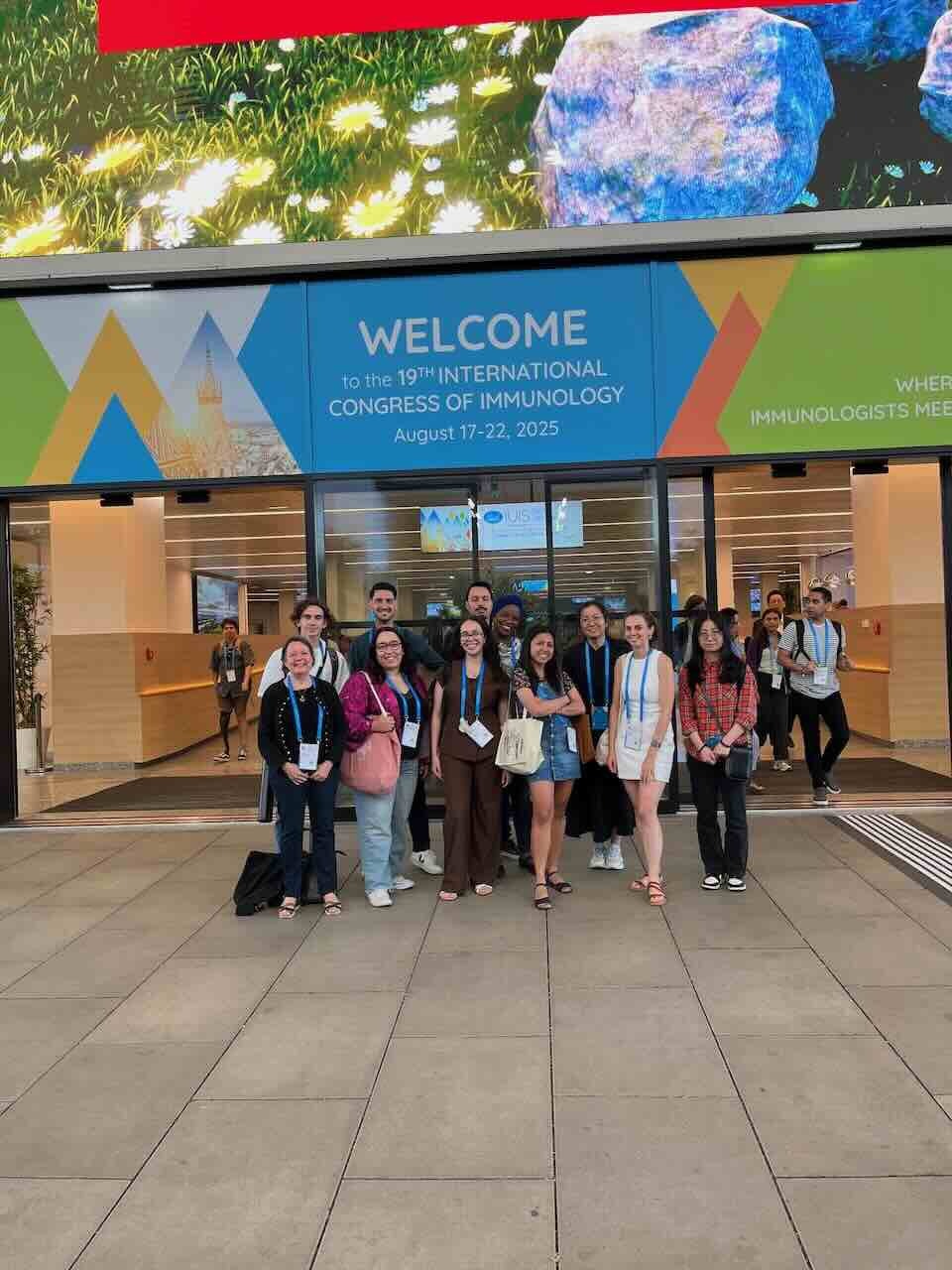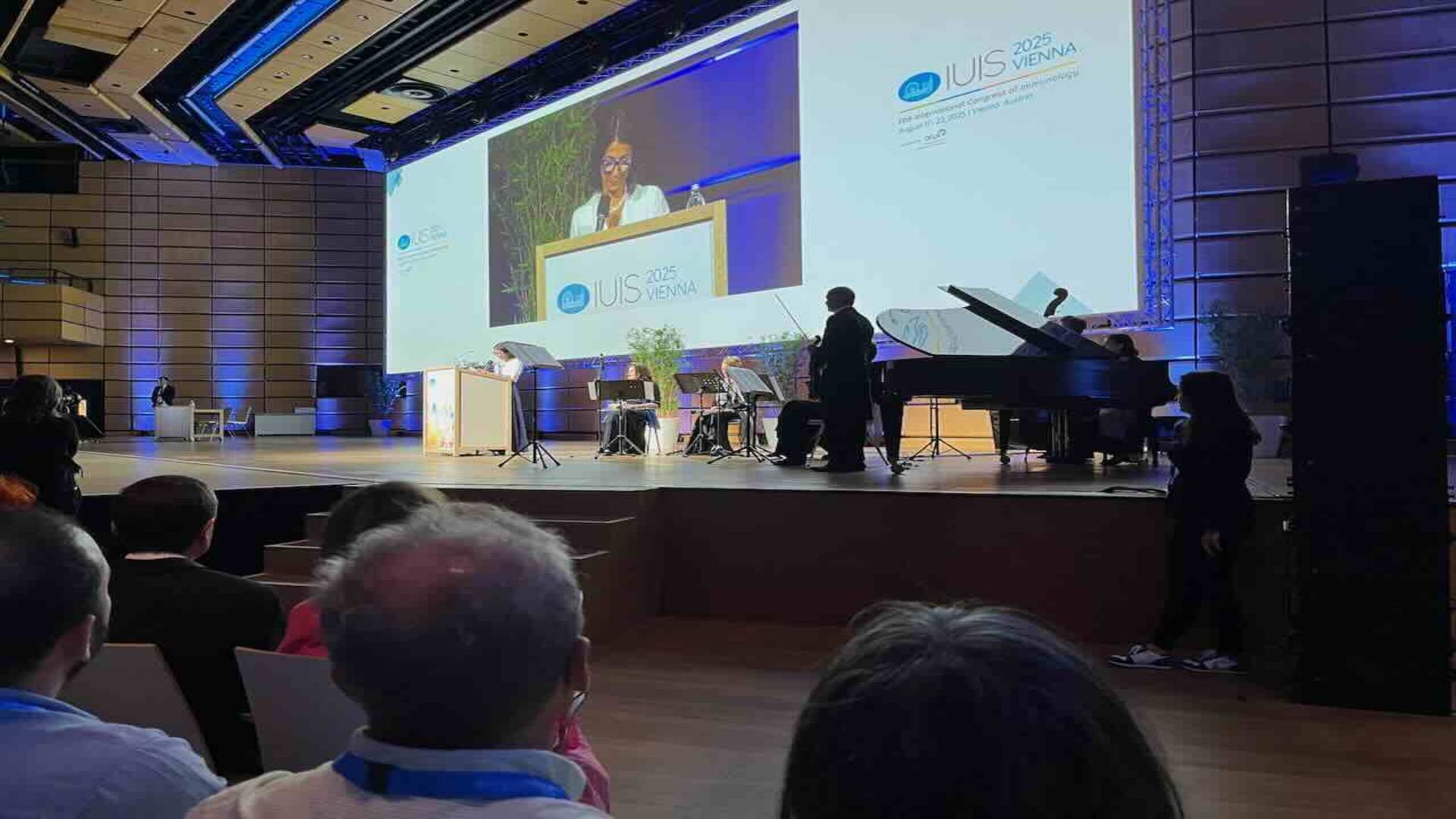
The Immunology and Immunopathology IHM funded registrations to the 19th IUIS International Congress of Immunology for the following young researchers : Mehdi KHELFA, Fatoumata SAMASSA, Renan OLIVEIRA-CORREA, Sijing LI.
IUIS 2025 gathered 3000 immunologist from the first continents. This landmark event of the year took place in Vienna, Austria, 17th till 22nd of August 2025. The IHM presents reports and abstracts from the laureates.
Fatoumata SAMASSA, post-doctoral researcher at Institut Cochin, outlined several highlights
🔬 Shimon SAKAGUCHI (Osaka University, emeritus, Kyoto University, Nobel Prize in Physiology and Medicine 2025) presented a keynote lecture. He explained how converting effector T cells into regulatory T cells (Tregs) represents a promising strategy to restore antigen-specific tolerance in autoimmune diseases. By inducing FoxP3 expression and Treg-specific epigenetic reprogramming, stable, antigen-specific iTregs were generated. This approach showed efficacy in models of pemphigus vulgaris, GVHD, and IBD, paving the way for targeted Treg-based immunotherapy.
🍼 Yasmine BELKAID (Institut Pasteur) presented a keynote lecture. She delivered a brilliant keynote lecture on a unique population of T-bet⁺ intraepithelial lymphocytes that accumulate in the mammary gland during pregnancy and lactation, promoting milk production by enhancing epithelial function and alveolar contraction.
🧬 Dmitry CHUDAKOV (EITEC (Czechia), ADSCC (UAE)) gave a fascinating talk on “hunting for autoimmune T cell clones”, presenting a strategy for the targeted depletion of pathogenic T cell clones as a potential cure for autoimmune diseases.
🧠 Michel ENAMORADO (Icahn School of Medicine at Mount Sinai) also gave an inspiring presentation on the complex interactions between the microbiota, neurons, and the immune system. Can’t wait to read the paper when it’s out!
🔬 Lucy WALKER (University College of London) gave a compelling talk on fine-tuning T cell responses through the CD28/CTLA-4 axis in Type 1 Diabetes, particularly in the context of Abatacept treatment. She presented an innovative combination therapy with low-dose IL-2 to restore Treg homeostasis impaired by costimulation blockade, offering protection against T1D in preclinical models.
🧬 Renan V. H. DE CARVALHO (Scripps Research Institute) presented during the adaptive immunity rising star session, a fascinating strategy to identify cells interacting with long-lived plasma cells using the Rosa uLIPSTIC mouse model — a powerful tool to study the plasma cell niche.
🦠 Camila COELHO (Icahn School of Medicine at Mount Sinai) delivered a passionate and impressive talk on the discovery of high-affinity monoclonal antibodies against mpox in mice and very exciting observations in human — exciting translational potential!
🏆 It was also an honor to hear from Arlene SHARPE (Harvard Medical School) recipient of the EXCELL Award IUIS 2025, who gave a seminal and inspiring presentation on a CRISPR screening platform designed to uncover novel therapeutic targets for cancer immunotherapy.
Renan OLIVEIRA CORRÊA, postdoctoral researcher at Institut Imagine highlighted Ruslan MEDZHITOV‘s keynote lecture.
Allergies are on the rise, especially in Western countries. The “hygiène hypothesis” suggests that reduced contact with microbes may leave our immune system less prepared to defend against disease.
Pr. Ruslan MEDZHITOV (Yale School of Medicine, USA), presented unpublished work comparing ” clean” SPF mice (genetically identical) with “dirtier” pet-shop mice (genetically variable), with richer microbial exposure, His findings indicate that :
- Pet-shop mice developed protective type I immune responses, which protected them from allergies.
- On the other hand, SPF mice developed allergy-prone type II responses
- Fostering and co-housing experiments confirmed this protectived effect is environnemental (not due to genetic factors).
- Interestingly, early-life exposure to allergens made pet-shop animals less susceptible to allergies later in life, reinforcing the fact that encountering a richer microbial community during early developmental stages is critical to the proper developmenet of the immune responses.
Pr.Medzhitov explained that a “clean” environnement creates a limited immune memory, leaving space for potentially pathogenic responses later. In contrast, an antigen-rich environnement builds a broader immune memory that reduces the risk of harmful responses.
In summary, the immune system appears to balance exploration vs exploitation, optimizing protection for both ongoing and anticipated challenges.
SIJing LI, post doctoral fellow on Metabolism, Cancer and Immunity Team, Centre de recherche des Cordeliers outlined Professor Xiaoyu HU’s plenary talk :
Excessive type 2 immune responses underlie allergic diseases, yet the mechanisms that restrain this pathway are not fully understood. He presented findings from a recenty study published in Science Immunology (July 4,2025). The work reveals that intestina tuft cells, traditionnaly viewed as initiatorts of type 2 immunity, also harbor an intrinsic suppressive program that keeps these responses in check.
Xiaoyu HU :
- Highlighted the paradoxical role of tuft cells as both initiators and regulators of type 2 immunity
- Emphasized the clinical revelance : reduced Spi-B and elevated c-Kit/TLSP signatures were observed in human food allergy, pointing to translational potential.
- Presented the therapeutic angle : targeting epithelial-intrinsic checkpoints (like Spi-B-Kit-TLSP) could current complement biologics against IL-4/IL-13/TLSP.
- Positioned this work as a paradigm shift, epithelial cells (not just immune cells) serve as gatekeepers that prevent harmful allergic inflammation.
Thus, Th2 (Type 2 helper T) cells play a complex role in cancer, acting as both friend and foe. On one hand, they can contribute to anti-tumor defenses by recruiting eosinophils and supporting barrier integrity. On the other hand, chronic Th2 signaling driven by IL-4, IL-13, TSLP, and tuft cell dysregulation, often promotes tumor growth, immune evasion, and a pro-tumor microenvironment. This talk highlights novel opportunities to modulate Th2 immunity, offering therapeutic avenues that restrain its tumor-promoting effects while harnessing its protective potential.
Mehdi KHELFA, post doctoral fellow at Institut Cochin :
Thomas KRAUSGUBER (MedUni Vienna, Austria) was also honored in immunomethabolism rising star session :
We know that most biological processes require both immune and structural cells, however the impact of structural cells on the phases of the immune response is often overlooked. Thomas Krausgruber’s group uses viral models to study the different phases of the immune response and the outcomes after acute infection: chronic inflammation or resolution of the infection. Their goal is to map tissue immunity over the course of chronic and acute immune responses. For this, they use two strains of Lymphocytic ChorioMeningitis Virus (LCMV) in mice models.
First, they showed that LCMV, independently of the strain, induces changes in immune cell proportions. In addition, they showed a dynamic response of structural cells (endothelial cells, epithelial cells and fibroblasts) to LCMV infection. They use combined single cell transcriptome sequencing + single cell viral sequencing with the widely known gel bead-in-emulsion technology.
Using this technique, by UMAP visualization, they showed that structural cells display tissue-specific transcriptomic profiles and that LCMV targets structural cells across organs differentially. The raised question was the role of the structural cells in a tissue-specific manner in the immune response. They notably found that structural cells control chemokine ability through two distinct mechanisms: production and scavenging. They highlighted different tissue-specific functions of structural cells:
- Endothelial cells in the intestine support cell mobility upon infection.
- Epithelial cells in the liver upregulate anti-viral immunity and antigen presentation.
- Fibroblasts in the lung execute immune and remodeling functions.
Overall, by assessing all these tissue-specific functions, they are currently comparing the transcriptomic profiles of structural cell to myeloid cells to determine which genes are upregulated or downregulated depending on the tissue and on the infection profile, a very pioneering approach.
Akira TAKEDA (MediCity Research Laboratory and Institute of Biomedicine, Turku, Finland) was also honored in the cancer immunology rising star session. His team performs mainly single-cell level analyses of metastatic and non-metastatic lymph nodes in combination with Cellular Indexing of Transcriptomes and Epitopes by Sequencing (CITE-seq). In one study, they found heterogeneity in LAMP3+ dendritic cells (DC), validated by flow cytometry. Some studies show that overall, these DC can promote immune evasion in some malignant pathologies. So, they co-cultured them with T cells for five days to assess their function. In the T cell compartment, they mainly looked at ICOS+ PD1-high cells that proliferated in the culture (CellTrace low).
Interestingly, in the subpopulations of LAMP3+ DC, they found that particularly CD1b+ DC induced stem-like CD4+ T cells. In order to know how these DC induced stem-like T cells, they collected supernatants from the co-cultures, split proteins with a molecular weight of less or more than 100 kilodaltons and added each fraction to naive CD4+ T cells.
They found that the fraction higher than 100 kilodaltons indeed induced these stem-like T cells. To precisely determine the factor polarizing T cells, they used mass spectrometry and concluded that this factor was an immunoregulatory extracellular vesicle (EV) expressing MHC class 2. They called these EVs “regsomes” in reference to “regulation” and “exosomes”. Thus, by combining different approaches and capitalizing on successive findings, they were able to make an impactful discovery in the field of cell-cell communication in lymph nodes.
Finally, in order to highlight the abstracts of the IUIS 2025 laureates, please find attached abstracts and links :
The abstract of the oral presentation at the rising star adaptive immunity session Renan Oliveira CORRÊA, France
Monocyte-derived LysoDCs mediate distinct Th17 immunity in Peyer’s patches driven by segmented filamentous bacteria :
The link for the abstract of the poster presented by Fatoumata SAMASSA, (France)
Interferon-α promotes HLA-B-restricted presentation of conventional and alternative antigens in human pancreatic β-cells
And finally, the link for the abstract of the poster presented by Mehdi KHELFA :
HIV-1-infected CD4+T cells induce human plasmacytoid DC diversification in vitro